40cm in inches: The Precise Conversion You Need for Everyday Use

Understanding measurements isn’t just about numbers—it’s about precision in a world where dimensions dictate everything from clothing fits to architectural blueprints. A miscalculation of 40cm in inches could mean the difference between a perfectly tailored suit and an ill-fitting garment, or between a structural flaw and a seamless construction project. The metric system’s dominance in science and industry contrasts sharply with the imperial system’s lingering grip in everyday life, particularly in the U.S. and U.K. This disparity creates a persistent need for accurate conversions, where 40cm in inches isn’t just a mathematical exercise but a practical necessity.
The confusion often stems from a lack of intuitive grasp of how centimeters translate to inches. For instance, while a 30cm ruler might feel familiar to those accustomed to metric units, the leap to 40cm in inches—a length roughly equivalent to a standard laptop screen’s diagonal—requires mental recalibration. This is especially true in fields like interior design, where wall measurements in centimeters must align with furniture dimensions in inches, or in fashion, where garment patterns shift between systems. The stakes are higher than mere convenience; they involve cost, efficiency, and even safety.
Even seasoned professionals occasionally stumble when faced with 40cm in inches conversions. A carpenter measuring a door frame, a fashion designer drafting a pattern, or an engineer reviewing a blueprint might hesitate if the units aren’t clearly labeled. The ambiguity isn’t just theoretical—it manifests in real-world scenarios, from misaligned shelves to incorrectly sized prototypes. Bridging this gap requires more than a quick calculator lookup; it demands an understanding of the underlying systems and their quirks.
The Complete Overview of 40cm in Inches
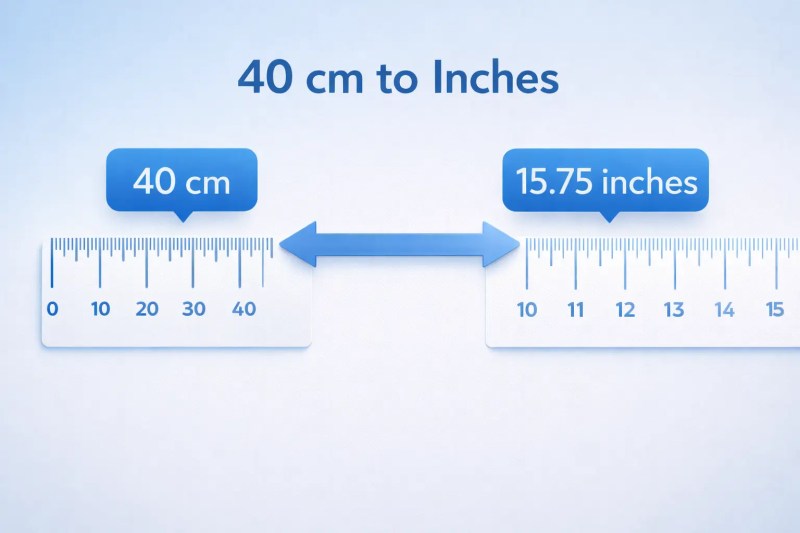
The conversion of 40cm in inches is a fundamental metric-to-imperial translation, but its implications extend far beyond a simple arithmetic operation. At its core, this measurement represents a bridge between two systems of units that coexist in global commerce, technology, and daily life. While the metric system (centimeters) is the standard in most of the world, the imperial system (inches) persists in industries like aviation, construction, and even digital screens. Knowing 40cm in inches isn’t just about solving for x; it’s about contextualizing how this length applies in different fields—whether it’s the width of a smartphone, the height of a child’s growth spurt, or the depth of a machinery component.The conversion itself is straightforward: 40cm equals approximately 15.748 inches. However, the precision required in certain contexts—such as manufacturing tolerances or medical measurements—means rounding to 15.75 inches might introduce unacceptable errors. This is why professionals often use exact values (1 inch = 2.54 cm) rather than rounded approximations. The discrepancy between metric and imperial units isn’t just a matter of preference; it reflects historical, cultural, and practical differences in how societies measure the world. For example, a 40cm in inches measurement might be second nature to a European tailor but require a double-check for an American contractor.
Historical Background and Evolution
The tension between metric and imperial units traces back to the French Revolution, when the metric system was introduced as a universal, decimal-based standard to eliminate the chaos of regional measurements. Meanwhile, the imperial system—rooted in British traditions—relied on arbitrary units like the inch, defined as the width of a man’s thumb. This duality persisted as empires expanded, with the U.S. and U.K. retaining imperial units for practical and cultural reasons. Today, 40cm in inches conversions serve as a microcosm of this global divide, where one system’s precision clashes with the other’s familiarity.The persistence of imperial units in certain industries stems from legacy systems. For instance, aircraft parts are still measured in inches because historical designs were standardized that way. Meanwhile, the metric system’s adoption in science and medicine ensures that 40cm in inches conversions are critical in fields like radiology, where patient measurements must align with diagnostic tools. The evolution of technology—particularly digital screens—has further blurred the lines, as manufacturers often list dimensions in both systems to cater to global markets. Understanding the history behind these units reveals why 40cm in inches isn’t just a calculation but a reflection of how measurement systems have shaped human progress.
Core Mechanisms: How It Works
The conversion from centimeters to inches relies on a fixed ratio: 1 inch = 2.54 cm. To find 40cm in inches, you divide the centimeter value by 2.54, yielding approximately 15.748 inches. This process is rooted in the International Yard and Pound Agreement of 1959, which standardized the inch to exactly 2.54 cm, ending decades of minor variations. The precision of this conversion is non-negotiable in fields like engineering, where even a fraction of an inch can affect performance. For example, a 40cm in inches measurement for a pipe fitting must be exact to prevent leaks or structural failures.Table of Contents
- The Complete Overview of 40cm in Inches
- Historical Background and Evolution
- Core Mechanisms: How It Works
- Key Benefits and Crucial Impact
- Major Advantages
- Comparative Analysis
- Future Trends and Innovations
- Conclusion
- Comprehensive FAQs
- Q: Why is the conversion of 40cm to inches not a round number?
- Q: How do I quickly estimate 40cm in inches without a calculator?
- Q: Are there industries where 40cm in inches is more critical than others?
- Q: Does the U.S. or U.K. use 40cm in inches more frequently?
- Q: Can I use 40cm in inches interchangeably with 15.75 inches in all cases?
- Q: How does digital technology affect the need for 40cm in inches conversions?
- Q: What’s the most common mistake when converting 40cm to inches?
- Q: Are there cultural differences in how 40cm in inches is interpreted?
- Q: How does climate affect the practicality of 40cm in inches conversions?
- Q: Can I convert 40cm in inches using a smartphone app?
Beyond basic arithmetic, the conversion involves understanding contextual applications. In fashion, 40cm in inches might refer to the length of a dress hem, where fabric patterns are often drafted in centimeters but sewn in inches. In technology, a 40cm monitor’s diagonal is typically converted to inches for marketing (e.g., a 40cm screen ≈ 15.75 inches). The key is recognizing when to use exact values versus rounded ones—engineering demands precision, while general use might tolerate slight approximations. This duality underscores why 40cm in inches is more than a number; it’s a tool for accuracy across disciplines.
Key Benefits and Crucial Impact
The ability to accurately convert 40cm in inches isn’t just a technical skill—it’s a gateway to efficiency, cost savings, and error reduction. In manufacturing, for instance, a miscalculation could lead to rejected batches or delayed shipments. For designers, it ensures that prototypes match client expectations. Even in everyday tasks, like hanging wall art or assembling furniture, knowing 40cm in inches prevents frustration and wasted materials. The impact of precise conversions extends to global trade, where products must meet international standards regardless of the units used in production.This conversion also fosters cross-cultural collaboration. A team in Germany working with a U.S.-based client might draft plans in centimeters but need to communicate in inches for approval. Similarly, a fashion brand sourcing fabric from Europe but selling in the U.S. must reconcile 40cm in inches measurements to avoid sizing discrepancies. The benefits aren’t just operational; they’re strategic, enabling businesses to operate seamlessly across borders.
"Measurement is the first step that leads to control and, eventually, to mastery." — Lord Kelvin, Physicist
Major Advantages
- Precision in Manufacturing: Ensures components fit correctly, reducing waste and rework. For example, a 40cm in inches part must align with imperial-marked machinery.
- Global Compatibility: Facilitates collaboration between metric and imperial systems, critical in international projects.
- Cost Efficiency: Avoids material overages or undersupply by matching measurements to exact specifications.
- Design Accuracy: Prevents errors in blueprints, prototypes, or digital models where units must switch mid-process.
- Consumer Trust: Accurate labeling (e.g., 40cm in inches for clothing) builds credibility and reduces returns.

Comparative Analysis
| Metric (Centimeters) | Imperial (Inches) |
|---|---|
| 40 cm | 15.748 inches (exact) |
| Common Use Cases | Fashion sizing, small electronics, interior design |
| Industries Relying on Conversion | Textiles, aerospace, digital displays |
| Precision Requirement | High (engineering), Moderate (general use) |
Future Trends and Innovations
As technology advances, the need for 40cm in inches conversions may evolve alongside it. AI-powered tools are already automating unit conversions, reducing human error in real-time. However, the persistence of imperial units in niche industries suggests that manual conversions won’t disappear entirely. Future innovations, such as augmented reality (AR) measurement tools, could overlay metric and imperial units in real-world applications, making 40cm in inches translations instantaneous. Meanwhile, global standardization efforts may push for metric adoption in more sectors, though cultural inertia will likely keep imperial units relevant for decades.The rise of e-commerce also highlights the importance of seamless conversions. Online retailers must display 40cm in inches equivalents to cater to international customers, requiring dynamic pricing and sizing systems. As cross-border trade grows, the ability to fluidly switch between units will become even more critical. The future of 40cm in inches isn’t just about math—it’s about adapting to a world where measurement systems continue to intersect.
Conclusion
Mastering the conversion of 40cm in inches is more than a technical exercise; it’s a practical skill with real-world consequences. Whether you’re a professional navigating global standards or a consumer ensuring a perfect fit, precision matters. The coexistence of metric and imperial systems ensures that this conversion will remain relevant, demanding both accuracy and adaptability. As industries evolve, so too will the tools and methods for handling 40cm in inches, but the core principle—understanding the relationship between units—will endure.For now, the key takeaway is simple: 40cm in inches is 15.748 inches, but the context in which you use this conversion defines its impact. From tailoring to engineering, the ability to bridge these systems is a skill that transcends borders and disciplines. In a world where measurements dictate success, knowing 40cm in inches isn’t just useful—it’s essential.
Comprehensive FAQs
Q: Why is the conversion of 40cm to inches not a round number?
A: The conversion relies on the exact definition of 1 inch as 2.54 cm, a ratio that doesn’t divide evenly into 40. Rounding to 15.75 inches introduces a 0.002-inch error, which is negligible in casual use but critical in precision engineering.
Q: How do I quickly estimate 40cm in inches without a calculator?
A: Use the approximation that 1 cm ≈ 0.3937 inches. For 40cm, multiply by 0.4 to get ~16 inches, then adjust downward by ~0.25 inches (40 × 0.3937 ≈ 15.748). This mental shortcut works for rough estimates.
Q: Are there industries where 40cm in inches is more critical than others?
A: Yes. Aerospace, medical device manufacturing, and high-precision machining require exact 40cm in inches conversions to ensure safety and functionality. Even a slight error can lead to catastrophic failures.
Q: Does the U.S. or U.K. use 40cm in inches more frequently?
A: The U.K. uses both systems but leans toward metric in daily life, while the U.S. retains imperial for most applications. However, 40cm in inches conversions are common in both for trade, technology, and design.
Q: Can I use 40cm in inches interchangeably with 15.75 inches in all cases?
A: No. While 15.75 inches is a practical rounded value, exact conversions (15.748 inches) are necessary in engineering, manufacturing, and scientific contexts where tolerances are tight.
Q: How does digital technology affect the need for 40cm in inches conversions?
A: Digital tools (CAD software, AR measurement apps) now automate conversions, reducing manual errors. However, professionals still need to verify outputs, especially in critical applications.
Q: What’s the most common mistake when converting 40cm to inches?
A: Using 1 inch = 2.5 cm (a common misconception) instead of 2.54 cm, leading to a 1.6% overestimation (40cm ≈ 16 inches instead of 15.748). Always use the exact ratio.
Q: Are there cultural differences in how 40cm in inches is interpreted?
A: Yes. In metric-dominant cultures, 40cm is a primary reference, while in imperial regions, visualizing 15.75 inches may be more intuitive. This discrepancy can cause confusion in collaborative projects.
Q: How does climate affect the practicality of 40cm in inches conversions?
A: Indirectly. In colder climates, imperial units persist due to historical resistance to change, while metric adoption is faster in regions with strong scientific traditions. However, climate itself doesn’t alter the conversion—it influences unit preference.
Q: Can I convert 40cm in inches using a smartphone app?
A: Absolutely. Apps like Google’s built-in calculator or specialized unit converters provide instant, precise 40cm in inches translations. For critical use, cross-verifying with manual calculations is advisable.
Leave a Comment
Comments are moderated before appearing. The data you submit is processed according to the Privacy Policy of Surfchex.