Python String Splitting Demystified: The Definitive Guide to How to Split a String in Python

Python’s string-splitting capabilities are foundational for data processing, text analysis, and automation tasks. The operation—often framed as "how to split a string in Python"—is deceptively simple yet underpins complex workflows, from parsing CSV files to tokenizing natural language. Developers frequently encounter scenarios where raw text must be decomposed into manageable components, and Python’s `str.split()` method serves as the primary tool. Its versatility extends beyond basic delimiters, accommodating regex patterns, custom separators, and even multi-character splits, making it indispensable for both beginners and seasoned engineers.
The elegance of Python’s string handling lies in its balance of simplicity and power. While other languages require verbose loops or external libraries, Python’s built-in methods handle 90% of splitting needs with minimal code. However, mastering the nuances—such as handling edge cases like empty strings, multiple delimiters, or non-string inputs—demands a deeper understanding. This guide dissects the mechanics, best practices, and performance considerations for splitting strings in Python, ensuring you can apply the technique confidently across projects.
The Complete Overview of How to Split a String in Python
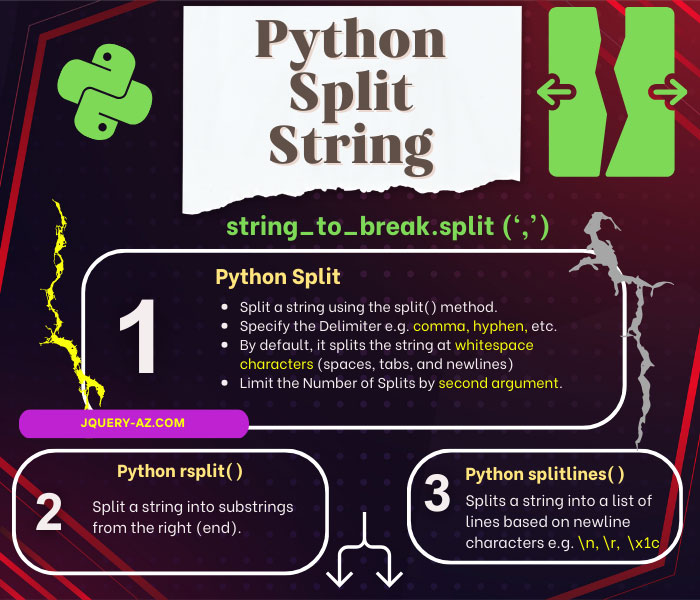
Python’s `str.split()` method is the cornerstone for decomposing strings into lists of substrings. At its core, it accepts a delimiter (defaulting to whitespace) and returns a list of the remaining segments. For example, `"hello.world".split(".")` yields `["hello", "world"]`. This operation is trivial for basic cases but becomes sophisticated when combined with optional parameters like `maxsplit` (limiting splits) or `str.rsplit()` (splitting from the right). The method’s design prioritizes readability while accommodating edge cases, such as consecutive delimiters or leading/trailing separators, which are collapsed into empty strings in the output.Beyond the standard `split()`, Python offers alternatives like `str.partition()` (splitting on the first occurrence) and `re.split()` (regex-based splitting). Each tool serves distinct use cases: `partition()` excels in extracting the first delimiter’s position, while `re.split()` handles complex patterns like splitting on punctuation or capturing groups. Understanding these variations is critical for optimizing performance and code clarity, especially when processing large datasets or parsing structured text.
Historical Background and Evolution
The concept of string splitting predates Python’s inception, evolving alongside programming languages as a necessity for text processing. Early languages like C required manual loops to iterate over delimiters, leading to verbose and error-prone code. Python’s designers, influenced by ABC and other high-level languages, prioritized simplicity, embedding `split()` into the core `str` type in Python 1.0 (1991). This decision reflected a broader trend toward abstraction, allowing developers to focus on logic rather than low-level implementation.Over time, Python’s string methods expanded to include `rsplit()`, `splitlines()`, and `split()`’s `maxsplit` parameter, addressing real-world needs like parsing logs or multi-line text. The introduction of the `re` module in Python 1.5 further revolutionized splitting by enabling regex patterns, bridging the gap between simple delimiters and complex text extraction. Today, `split()` remains a staple, though modern libraries like `pandas` or `nltk` abstract these operations for domain-specific tasks, demonstrating how Python’s foundational tools continue to adapt.
Core Mechanisms: How It Works
Under the hood, `str.split()` processes the string by scanning for the delimiter and dividing the input into substrings. The algorithm’s efficiency stems from a single pass through the string, though performance degrades with `maxsplit` due to additional checks. For instance, `"a,b,c".split(",")` creates a list of `["a", "b", "c"]` by locating commas and slicing the string accordingly. The method’s behavior with empty strings or consecutive delimiters (e.g., `"a,,b".split(",")` returning `["a", "", "b"]`) is intentional, preserving all segments for downstream processing.Python’s handling of Unicode and multi-byte characters ensures `split()` remains robust across languages. The method internally uses UTF-8 encoding, meaning delimiters like emojis or non-ASCII symbols are treated as single characters. This consistency is critical for global applications, where text may include Cyrillic, CJK, or other scripts. However, users must manually encode/decode strings when interfacing with external systems, as `split()` operates on Python’s native string type.
Key Benefits and Crucial Impact
The ability to split strings efficiently is a game-changer for data pipelines, where raw text must be transformed into structured formats. Whether parsing configuration files, cleaning datasets, or tokenizing user input, `split()` reduces boilerplate code and minimizes errors. Its integration with list comprehensions and other Python features further enhances productivity, allowing developers to chain operations like `map()` or `filter()` directly on split results.Table of Contents
- The Complete Overview of How to Split a String in Python
- Historical Background and Evolution
- Core Mechanisms: How It Works
- Key Benefits and Crucial Impact
- Major Advantages
- Comparative Analysis
- Future Trends and Innovations
- Conclusion
- Comprehensive FAQs
- Q: What happens if the delimiter isn’t found in the string?
- Q: How does `maxsplit` affect performance?
- Q: Can `split()` handle multi-character delimiters?
- Q: What’s the difference between `split()` and `re.split()`?
- Q: How do I split a string while preserving empty segments?
- Q: Is there a performance difference between `split()` and `rsplit()`?
- Q: Can I split a string on multiple delimiters at once?
- Q: How does `split()` behave with Unicode delimiters?
- Q: What’s the most efficient way to split a very large string?
- Q: Can I split a string and remove whitespace around segments?
Beyond functionality, Python’s string methods promote readability. A single line of code—`data = line.split(",")`—replaces pages of manual parsing logic, adhering to the principle of "explicit is better than implicit." This clarity is especially valuable in collaborative environments, where maintainable code accelerates teamwork. The method’s consistency across Python versions also ensures long-term reliability, a critical factor for mission-critical applications.
"String manipulation is the unsung hero of programming—it’s the difference between raw data and actionable insights." — Guido van Rossum (Python’s creator, paraphrased)
Major Advantages
- Simplicity: One-line syntax (`str.split()`) handles 80% of use cases without external dependencies.
- Flexibility: Supports custom delimiters, `maxsplit`, and regex via `re.split()` for advanced scenarios.
- Performance: Optimized for single-pass processing, making it suitable for large-scale text operations.
- Unicode Support: Natively handles multi-byte characters, ensuring global compatibility.
- Integration: Works seamlessly with Python’s ecosystem (e.g., `pandas.read_csv()` uses `split()` internally).
Comparative Analysis
| Method | Use Case |
|---|---|
str.split(sep, maxsplit) |
Basic splitting (e.g., CSV parsing, whitespace separation). Ideal for most scenarios. |
str.rsplit(sep, maxsplit) |
Right-to-left splitting (e.g., extracting file extensions: `"file.txt".rsplit(".", 1)` → `["file", "txt"]`). |
str.partition(sep) |
Splitting on the first occurrence, returning a 3-tuple (useful for simple key-value pairs). |
re.split(pattern, string) |
Complex patterns (e.g., splitting on punctuation or capturing groups). Overkill for simple cases. |
Future Trends and Innovations
As Python evolves, string manipulation methods may incorporate Just-In-Time (JIT) compilation to further optimize performance-critical splits. Projects like PyPy or Rust-based extensions could introduce specialized string processors, though backward compatibility will likely preserve `split()`’s current behavior. Meanwhile, the rise of machine learning-driven text processing (e.g., NLP libraries) may reduce reliance on manual splitting, as models handle tokenization internally. However, `split()` will remain relevant for low-level tasks, especially in constrained environments like embedded systems.The future also holds potential for standardized extensions to `split()`, such as built-in support for fuzzy matching or context-aware delimiters. Until then, developers should focus on mastering existing tools—`split()`, `rsplit()`, and `re.split()`—to ensure their code remains efficient and adaptable.
Conclusion
Mastering how to split a string in Python is more than a technical skill; it’s a gateway to efficient text processing. Whether you’re parsing logs, cleaning datasets, or building APIs, the ability to decompose strings with precision is non-negotiable. Python’s `split()` method exemplifies the language’s philosophy: powerful yet accessible, with room for customization when needed.For most tasks, `str.split()` is sufficient, but recognizing when to use `rsplit()`, `partition()`, or `re.split()` ensures optimal performance. As you integrate these techniques into your workflow, remember that clarity and consistency are paramount—Python’s string methods are designed to make your code both concise and maintainable.
Comprehensive FAQs
Q: What happens if the delimiter isn’t found in the string?
The entire string is returned as a single-element list. For example, `"hello".split("x")` yields `["hello"]`. This behavior ensures consistency even with mismatched delimiters.
Q: How does `maxsplit` affect performance?
Using `maxsplit` increases time complexity from O(n) to O(n + k), where k is the number of splits. For large strings, omitting `maxsplit` is generally faster unless you explicitly need to limit splits.
Q: Can `split()` handle multi-character delimiters?
Yes. For example, `"a--b--c".split("--")` returns `["a", "b", "c"]`. The delimiter is treated as a single unit, making it useful for parsing structured text like URLs or paths.
Q: What’s the difference between `split()` and `re.split()`?
`split()` uses literal strings as delimiters, while `re.split()` accepts regex patterns. For instance, `re.split(r"[\s,;]+", text)` splits on whitespace, commas, or semicolons—something `split()` cannot do natively.
Q: How do I split a string while preserving empty segments?
By default, `split()` includes empty strings for consecutive delimiters (e.g., `"a,,b".split(",")` → `["a", "", "b"]`). To exclude them, use a list comprehension: `[x for x in s.split(",") if x]`.
Q: Is there a performance difference between `split()` and `rsplit()`?
No. Both methods have identical time complexity (O(n)), though `rsplit()` processes the string from the end. The choice depends on the use case (e.g., `rsplit()` for file extensions).
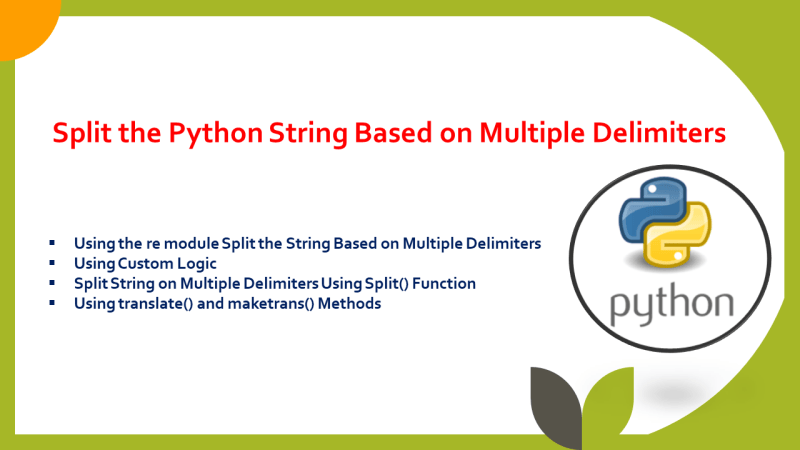
Q: Can I split a string on multiple delimiters at once?
With `split()`, no—but `re.split()` handles this via patterns. For example, `re.split(r"[,;]", text)` splits on commas or semicolons. For simple cases, pre-processing (e.g., replacing delimiters) may suffice.
Q: How does `split()` behave with Unicode delimiters?
It treats Unicode characters (e.g., emojis, non-ASCII symbols) as single delimiters. For example, `"hello😊world".split("😊")` works as expected. However, ensure the delimiter’s encoding matches the string’s encoding.
Q: What’s the most efficient way to split a very large string?
For memory efficiency, process the string in chunks or use generators. For example, `itertools.groupby` can split large files line-by-line without loading everything into memory.
Q: Can I split a string and remove whitespace around segments?
Yes. Combine `split()` with `strip()`: `[x.strip() for x in s.split(",")]`. This trims leading/trailing whitespace from each segment.
Leave a Comment
Comments are moderated before appearing. The data you submit is processed according to the Privacy Policy of Surfchex.