Mastering Python Deque: The Double-Ended Powerhouse for High-Performance Data Handling

Python’s deque (double-ended queue) is a specialized data structure that bridges efficiency and flexibility, offering operations at both ends of a sequence with near-constant time complexity. Unlike traditional lists, which degrade in performance with frequent insertions or deletions at the beginning, a python deque maintains O(1) complexity for append/pop operations at either end. This makes it indispensable for scenarios demanding rapid data manipulation—from real-time systems to complex algorithms.
The elegance of the python deque lies in its simplicity: a thread-safe, memory-efficient container that extends beyond basic queue functionality. Whether managing task queues, implementing sliding windows, or optimizing memory-intensive operations, its design anticipates the needs of modern Python developers. Yet, its adoption remains underappreciated outside niche applications, despite its critical role in libraries like `asyncio` and `heapq`.
What sets the python deque apart is its ability to handle large datasets without sacrificing speed. While lists excel in random access, they falter when faced with repeated prepend operations—a scenario where a python deque shines. This dual-edge capability is not just a technical detail but a paradigm shift in how Python handles dynamic collections.
The Complete Overview of Python Deque
The python deque is a container adaptable to both LIFO (stack) and FIFO (queue) paradigms, thanks to its symmetric append/pop operations. Introduced in Python 2.4 as part of the `collections` module, it addresses a fundamental limitation of lists: the O(n) time complexity of inserting or removing elements at the front. By leveraging a doubly-linked list under the hood, the python deque achieves amortized O(1) performance for these operations, making it a cornerstone for high-frequency data processing.Its versatility extends to memory management, where it dynamically resizes by allocating blocks of memory in chunks rather than doubling in size like lists. This approach minimizes fragmentation and overhead, particularly beneficial for long-running applications. Developers often overlook its role in performance-critical paths, yet its impact is measurable—whether in reducing latency in web servers or accelerating numerical computations.
Historical Background and Evolution
The concept of a double-ended queue predates Python, emerging in early computer science literature as a solution to the inefficiencies of linear data structures. However, Python’s implementation in 2004 marked a turning point, embedding it directly into the standard library. Raymond Hettinger, a key contributor, designed it to complement the `list` type, offering a specialized tool for scenarios where bidirectional access was non-negotiable.Early versions of the python deque were constrained by memory overhead, but optimizations in later Python releases—particularly the use of a circular buffer for small sizes and linked blocks for larger ones—refined its efficiency. Today, it stands as a testament to Python’s iterative improvements, balancing theoretical elegance with practical utility.
Core Mechanisms: How It Works
At its core, the python deque combines the predictability of a linked list with the cache efficiency of a contiguous array. For small datasets, it uses a fixed-size array (default: 64 elements), while larger datasets trigger a shift to a linked structure of blocks. This hybrid approach ensures that operations at both ends remain O(1), regardless of the underlying implementation.Table of Contents
- The Complete Overview of Python Deque
- Historical Background and Evolution
- Core Mechanisms: How It Works
- Key Benefits and Crucial Impact
- Major Advantages
- Comparative Analysis
- Future Trends and Innovations
- Conclusion
- Comprehensive FAQs
- Q: When should I use a python deque over a list?
- Q: Can a python deque replace a stack or queue?
- Q: How does the python deque handle thread safety?
- Q: What’s the maximum size of a python deque ?
- Q: Are there performance trade-offs for using a python deque ?
The magic lies in its internal pointers: `_p` (start) and `_q` (end), which track the logical boundaries of the data. When the deque exceeds its capacity, it appends a new block, maintaining contiguous memory access. This design choice is critical for performance, as it avoids the costly reallocations that plague dynamic arrays.
Key Benefits and Crucial Impact
The python deque is not merely an alternative to lists—it’s a performance multiplier for applications where latency matters. In financial trading systems, for example, it enables millisecond-level order processing by minimizing the overhead of queue operations. Similarly, in data streaming pipelines, its ability to efficiently append and pop from both ends reduces bottlenecks that would cripple slower structures.Beyond raw speed, the python deque excels in memory efficiency. Unlike lists, which may allocate excessive memory during resizing, it grows incrementally, reducing waste. This trait is particularly valuable in embedded systems or environments with constrained resources, where every byte counts.
"The deque is Python’s answer to the need for a fast, flexible container that doesn’t compromise on memory or speed. It’s the unsung hero of high-performance Python code." — Raymond Hettinger (Python Core Developer)
Major Advantages
- Bidirectional Operations: Append/pop from either end in O(1) time, unlike lists (O(n) for front operations).
- Memory Efficiency: Dynamically resizes in blocks, reducing fragmentation compared to lists.
- Thread Safety (with Locks): Can be safely shared across threads when protected by `threading.Lock`.
- Stack/Queue Duality: Functions as both a stack (LIFO) and queue (FIFO) without structural changes.
- Built-in Rotations: The `rotate()` method enables efficient circular buffer operations, ideal for sliding windows.
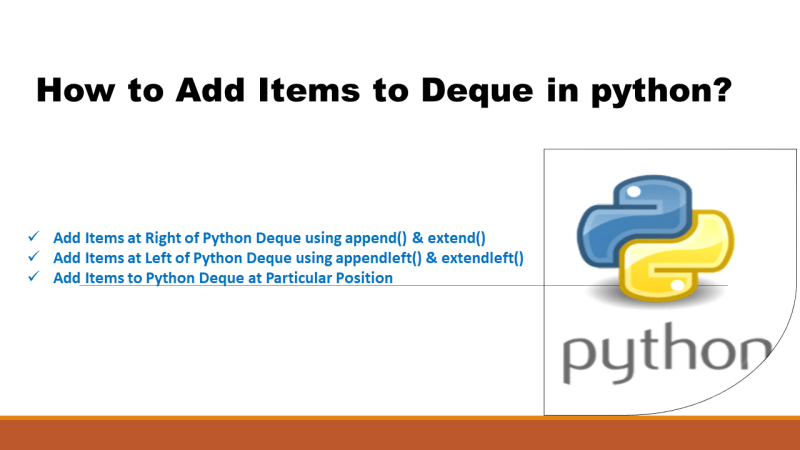
Comparative Analysis
| Feature | Python Deque | List |
|---|---|---|
| Append/Pop at End | O(1) | O(1) amortized |
| Append/Pop at Front | O(1) | O(n) |
| Memory Overhead | Lower (block-based) | Higher (contiguous) |
| Use Case Fit | Queues, stacks, sliding windows | General-purpose, random access |
Future Trends and Innovations
As Python evolves, the python deque may see further optimizations, particularly in its memory management. Experimental features like "memoryview-backed deques" could emerge, enabling zero-copy operations for numerical data. Additionally, integration with Rust’s `VecDeque` via Cython might unlock cross-language performance gains, though this remains speculative.The rise of async programming also hints at expanded use cases. Libraries like `asyncio` already leverage the python deque for task scheduling, and future versions may incorporate it into new concurrency primitives. Its role in machine learning pipelines—where batch processing demands efficient data shuffling—could also grow, as frameworks like TensorFlow explore Python-native optimizations.

Conclusion
The python deque is more than a data structure—it’s a paradigm for efficient computation. Its ability to handle bidirectional operations without sacrificing performance makes it a default choice for developers who demand precision. While lists remain indispensable for random access, the python deque reigns supreme in scenarios where speed and symmetry are non-negotiable.Understanding its mechanics isn’t just about writing faster code; it’s about designing systems that scale. Whether you’re optimizing a trading algorithm or building a real-time analytics engine, the python deque provides the tools to turn constraints into advantages.
Comprehensive FAQs
Q: When should I use a python deque over a list?
A: Use a python deque when you need frequent insertions/deletions at both ends or when memory efficiency is critical. Lists are better for random access or when the primary operations are appends at the end.
Q: Can a python deque replace a stack or queue?
A: Yes. A python deque can function as both a stack (using `append()` and `pop()`) and a queue (using `append()` and `popleft()`), offering more flexibility than dedicated stack/queue implementations.
Q: How does the python deque handle thread safety?
A: The python deque itself is not thread-safe. For concurrent access, wrap operations in a `threading.Lock` or use `multiprocessing.Queue` for inter-process safety.
Q: What’s the maximum size of a python deque?
A: The python deque has no hard-coded maximum size, limited only by system memory. However, very large deques may impact performance due to memory fragmentation.
Q: Are there performance trade-offs for using a python deque?
A: The primary trade-off is random access speed—python deque operations are O(1) at ends but O(n) for middle elements, unlike lists (O(1) for all indices). Choose based on your access patterns.
Leave a Comment
Comments are moderated before appearing. The data you submit is processed according to the Privacy Policy of Surfchex.