How Python’s Ternary Operator Simplifies Logic Without Sacrificing Readability
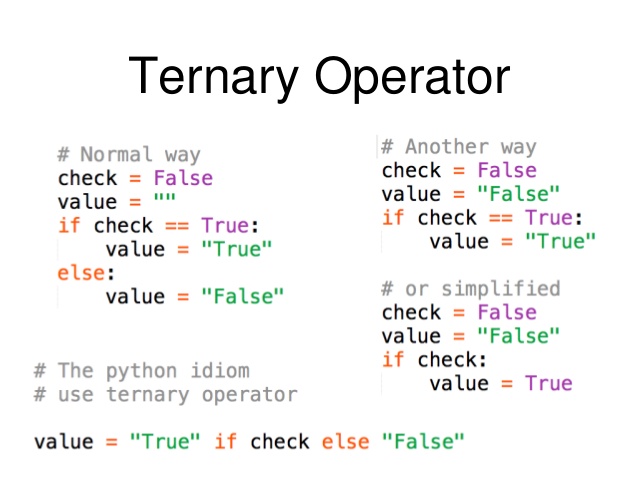
Python’s ternary operator is a deceptively powerful tool that condenses conditional logic into a single line. Unlike traditional if-else statements, it evaluates expressions directly, reducing boilerplate while maintaining clarity. Developers often overlook its potential, assuming it’s limited to trivial cases—yet its elegance lies in how it transforms repetitive checks into fluid, maintainable code.
The operator’s syntax mirrors mathematical ternary expressions (condition ? true_case : false_case), but Python’s implementation is more flexible. It thrives in scenarios where a single decision determines the outcome, such as assigning values, formatting strings, or controlling simple workflows. Its efficiency isn’t just about brevity; it’s about preserving readability when used judiciously.
Mastering the ternary operator in Python isn’t about memorizing syntax—it’s about recognizing patterns where it excels. Whether you’re processing data, optimizing loops, or writing clean APIs, understanding its nuances can elevate your code’s sophistication without compromising performance.
The Complete Overview of the Ternary Operator in Python
The ternary operator in Python, often called a conditional expression, is a syntactic shortcut for inline conditionals. It evaluates a condition and returns one of two values based on the result, eliminating the need for multi-line if-else blocks. This feature, introduced early in Python’s design, reflects the language’s philosophy of simplicity and expressiveness.At its core, the operator follows the structure:
`
This compact form is ideal for scenarios where a decision’s outcome is immediately actionable—such as setting default values, filtering lists, or dynamically formatting outputs. Unlike languages where ternary operators are rigid, Python’s version adapts seamlessly to complex expressions, provided the logic remains straightforward.
Historical Background and Evolution
Python’s ternary operator traces its roots to the language’s foundational design principles, championed by Guido van Rossum. Inspired by C’s ternary operator (`condition ? expr1 : expr2`), Python’s implementation prioritized readability and consistency. The decision to integrate it stemmed from the need to balance conciseness with clarity, avoiding the pitfalls of overly cryptic syntax.
Over time, the operator’s utility became evident in Python’s growing ecosystem. As the language evolved, so did its adoption—from scripting to large-scale applications. Modern Python (3.x) further refined its use, particularly in functional programming paradigms where concise expressions are favored. Today, it remains a staple in Python’s toolkit, though debates persist about its overuse in complex logic.
Core Mechanisms: How It Works
The ternary operator in Python operates by evaluating the `Table of Contents
- The Complete Overview of the Ternary Operator in Python
- Historical Background and Evolution
- Core Mechanisms: How It Works
- Key Benefits and Crucial Impact
- Major Advantages
- Comparative Analysis
- Future Trends and Innovations
- Conclusion
- Comprehensive FAQs
- Q: Can the ternary operator in Python handle multiple conditions?
- Q: Is the ternary operator faster than if-else statements?
- Q: Can I nest ternary operators in Python?
- Q: Does the ternary operator support side effects?
- Q: Are there alternatives to the ternary operator in Python?
For example:
```python
result = "Even" if x % 2 == 0 else "Odd"
```
Here, the condition `x % 2 == 0` dictates whether `"Even"` or `"Odd"` is assigned. The operator’s strength lies in its ability to embed conditions within larger expressions, such as:
```python
print(f"Status: {'Active' if user.is_active else 'Inactive'}")
```
This approach is particularly useful in list comprehensions or lambda functions, where brevity aligns with performance.
Key Benefits and Crucial Impact
The ternary operator in Python isn’t just a syntactic sugar—it’s a performance and maintainability multiplier. By reducing nested conditionals, it minimizes cognitive load, making code easier to debug and extend. Its impact is most pronounced in scenarios where readability and conciseness must coexist, such as data pipelines or API responses.Adopting the ternary operator aligns with Python’s Zen, which advocates for "simple is better than complex." When used appropriately, it transforms verbose logic into elegant, single-line solutions. However, its effectiveness hinges on discipline: overuse can obscure intent, defeating the purpose of clarity.
"Code is read much more often than it is written." — Guido van Rossum
Major Advantages
- Conciseness: Replaces multi-line if-else blocks with a single expression, reducing vertical space in code.
- Readability (when used wisely): Clearly communicates intent for simple conditions without sacrificing clarity.
- Performance: Avoids function call overhead compared to traditional conditionals in tight loops.
- Functional Programming Support: Integrates seamlessly with lambda functions and list comprehensions.
- Dynamic Value Assignment: Ideal for setting variables based on runtime conditions without branching.

Comparative Analysis
| Ternary Operator | Traditional if-else |
|---|---|
| Single-line expression | Multi-line block |
| Best for simple conditions | Better for complex logic |
| No function call overhead | Slightly slower in loops |
| Limited to one condition | Supports nested conditions |
Future Trends and Innovations
As Python continues to evolve, the ternary operator’s role may expand in response to emerging paradigms. Functional programming trends, for instance, could see increased use of ternary expressions in higher-order functions, where conciseness is critical. Additionally, tools like type hints (Python 3.5+) may encourage more disciplined use, ensuring operators are applied where they truly add value.Future Python versions might also introduce syntax extensions to clarify ambiguous cases, such as nested ternary operations. However, the core principle—balancing brevity with readability—will likely remain unchanged.

Conclusion
The ternary operator in Python is a testament to the language’s ability to combine power with simplicity. When wielded correctly, it transforms cumbersome conditionals into clean, efficient code. However, its misuse can lead to readability nightmares, reinforcing the need for thoughtful application.For developers, the key takeaway is context: use the ternary operator where it shines—simple decisions—and rely on traditional constructs for complexity. Mastery lies not in memorizing syntax, but in recognizing where each tool fits best.
Comprehensive FAQs
Q: Can the ternary operator in Python handle multiple conditions?
A: No. The ternary operator evaluates only one condition. For multiple conditions, use traditional if-elif-else chains or logical operators (e.g., `and`/`or`) within the condition.
Q: Is the ternary operator faster than if-else statements?
A: In most cases, yes—especially in loops—because it avoids function call overhead. However, the performance difference is negligible for most applications unless profiling reveals bottlenecks.
Q: Can I nest ternary operators in Python?
A: Technically yes, but it’s discouraged. Nested ternaries (e.g., `x if condition1 else y if condition2 else z`) reduce readability. Use if-else for clarity in such cases.
Q: Does the ternary operator support side effects?
A: Yes, but sparingly. While expressions like `print("A") if True else print("B")` work, they violate Python’s principle of least surprise. Prefer separate statements for side effects.
Q: Are there alternatives to the ternary operator in Python?
A: Yes. For complex logic, use if-else blocks, dictionary lookups (`{True: "A", False: "B"}[condition]`), or the `or`/`and` operators for default values.
Leave a Comment
Comments are moderated before appearing. The data you submit is processed according to the Privacy Policy of Surfchex.